When is management of European eel going to catch up with scientific advice?
Widespread exploitation of the critically endangered European eel population continues against scientific advice, despite no signs of recovery. Today, the International Exploration of the Sea, ICES, published its scientific advice on fishing opportunities and conservation for European eel for 2027. As in previous years, ICES advises zero catch for all life stages, all uses and in all habitats. Despite very clear advice, over 1,500 tonnes were landed commercially in the EU in 2025 with an additional > 300 tonnes taken in recreational fisheries.
The scientific advice on European eel requested by the EU, the UK and Norway makes very clear that no catches can be considered sustainable and that the “zero catch” also applies to glass eel landings used for restocking and aquaculture. Given the state of the eel population, ICES advises that all other anthropogenic impacts, such as pumping stations, hydropower and pollution, should also be zero.
The European eel (Anguilla anguilla) has been listed as Critically Endangered by IUCN since 2008, and is on the European Red List for freshwater fish. It is also included in Appendix II of the Convention on Migratory Species (CMS) and listed in Appendix II of the Convention on International Trade in Endangered Species of Wild Fauna and Flora (CITES) since 2007.
Despite the need for protection and efforts to aid its recovery, European eel continues to be fished across most of its natural range. In the past decade, total reported commercial landings of yellow and silver eel have remained above 2 000 tonnes per year; with several countries reporting annual landings of over 100 tonnes. In 2025, reported commercial glass eel landings were 57.1 tonnes. Where available, estimates of national recreational landings of yellow and silver eels show that they can be of the same order of magnitude as those of commercial fisheries. All in contradiction with the scientific advice. Only Ireland, Slovenia, Malta and Norway have closed all fishing for the species.
In the EU, the Council Regulation (EC) No 1100/2007 establishing measures for the recovery of the stock of European eel was adopted in 2007 – almost 20 years ago. Since then, there has been some fluctuations in the very low levels of recruitment and yellow eel index, but no recovery. For 2026, levels are extremely low again with recruitment for “Elsewhere Europe” at 6.4 % and North Sea index at 1.2 % of the 1960–1979 reference level, respectively.
– One has to wonder when European eel will be considered critically endangered enough for this exploitation to stop, says Niki Sporrong, Senior Policy Advisor for Migratory Fish at Coalition Clean Baltic. When will the obligation to protect and restore the population set out both in EU law and international agreements be prioritised?
Measures to aid eel recovery have been agreed and implemented across and beyond the EU.
Mediterranean long-term management measures for European eel were agreed in 2024 under the General Fisheries Committee for the Mediterranean (GFCM). Eel fishing closures, together with a complete ban of recreational fishing, intended to protect eel migration and recruitment have been adopted in EU marine waters, but their application has had insufficient effects on fishing mortality so far. Trade in European eel is regulated under CITES, and only earlier this year a
Single Species Action Plan for the full range of the population was adopted by the Convention on the Conservation of Migration of Wild Animals (CMS). But without properly addressing key threats such as fishing, migration barriers and habitat loss it is hard to see how even the resilient eel will be able to survive combined pressures further exacerbated by climate change.
– Exploitation of European eel continues against scientific advice, says Niki Sporrong. Agreed EU objectives for the rebuilding of fish stocks and biodiversity are simply not applied to this remarkable species. Urgent measures to minimise eel mortality must be implemented now, in both national, EU and international waters.
—END—
Notes to editors:
[1] The European eel (Anguilla anguilla) population has been declining for a long time and is classified as Critically Endangered by the International Union for Conservation of Nature (IUCN, 2018).
[2] The International Council for the Exploration of the Sea (ICES) data on recruitment shows a dramatic decline since the assessment baseline (1960-1979), and no significant recovery. Glass eel recruitment continues to be very low. This year, the preliminary estimate for the North Sea area is 1.2 % of the baseline average and for “elsewhere Europe” 6.4 %. Yellow eel recruitment in 2024 was estimated to 16.4 %.
[3] Assessment of European eel is complex due to the great geographical range of the population, including a number of countries outside of the ICES areas. This makes it impossible for ICES to use fishing mortality, Maximum Sustainable Yield (MSY) and other standard reference points for eel. As data on eel fisheries and other anthropogenic impacts remain incomplete, the assessment is based on time series for glass eel and yellow eel recruitment. Even without defined biological limit reference points, it is ICES’s assessment that the European eel population remains well below any potential reference points, such as Blim.
[4] ICES has advised that all anthropogenic mortality should be kept as close to zero as possible since 2003 (ICES, 2020). Since 2021, the advice has changed to zero for all anthropogenic mortalities, including all fishing.
[5] A Council Regulation (1100/2007) establishing measures for the recovery of the stock of European eel was agreed in 2007. Since then, almost 20 years after its adoption, no notable recovery has been observed in the European eel population.
[6] Only three EU countries – Ireland, Malta and Slovenia – have prohibited all fishing for the European eel, despite the fact that it is also on the European Red List of Freshwater Fishes. Six EU countries still landed over 100 tonnes in 2025: the Netherlands (428 t), France (361 t), Germany [extrapolated from latest reported landings of >200 t], Denmark (126 t), Poland (120 t) and Sweden (114 t). Outside of the EU, Turkey (267 t) also reported landings over 100 tonnes. Egypt, which has a substantial fishery for European eel and mainly targets yellow and silver eel, does not report any data to ICES and is not included in the overall estimates.
[7] Trends in landings – reported commercial landings of yellow and silver eel continue to fall overall. In 2024, landings were 2,074 tonnes and in 2025, landings were around 1,922 tonnes, if we assume that Germany landed >200 tonnes based on landings from recent years. However, France and Denmark stand out in 2025 for increasing reported commercial landings compared to the previous year, and the Netherlands for significantly increasing landings since the EU eel regulation was adopted.
[8] EU glass eel landings – in 2026, reported commercial landings of glass eel, a fishery completely dominated by France, were at 53 tonnes. In France, landings have been increasing since 2011 with a peak at 54.5 tonnes in 2022. This year, France reported landings of 48.3 tonnes (prel. figures) – 91% of the EU catch. After Brexit, UK landings have fallen dramatically, from more than 3 tonnes to 0.6 tonnes in 2025. Spain is the only country still fishing for glass eel in the Mediterranean, and the Mediterranean landings almost doubled in 2026.
[9] Recreational landings of yellow and silver eel are completely dominated by Germany. Total reported recreational landings for 2022 – the last year with complete figures – was 550 tonnes. In Germany, recreational landings remain very high, higher than reported commercial landings, with 275 tonnes reported for 2022. This is over half of all reported recreational landings in the EU (52%).
[10] Restocking involves catching wild glass eels in one place and letting them go in another, often spreading viruses and disease in the process. It has been used for decades in many countries – not as a conservation measure but in order to sustain fisheries for eel. Despite the prolonged practice, no net benefit to eel reproduction has been proven. In its advice for 2026, ICES notes that “restocking is reliant on a glass eel catch, which is in contradiction with the current advice”.
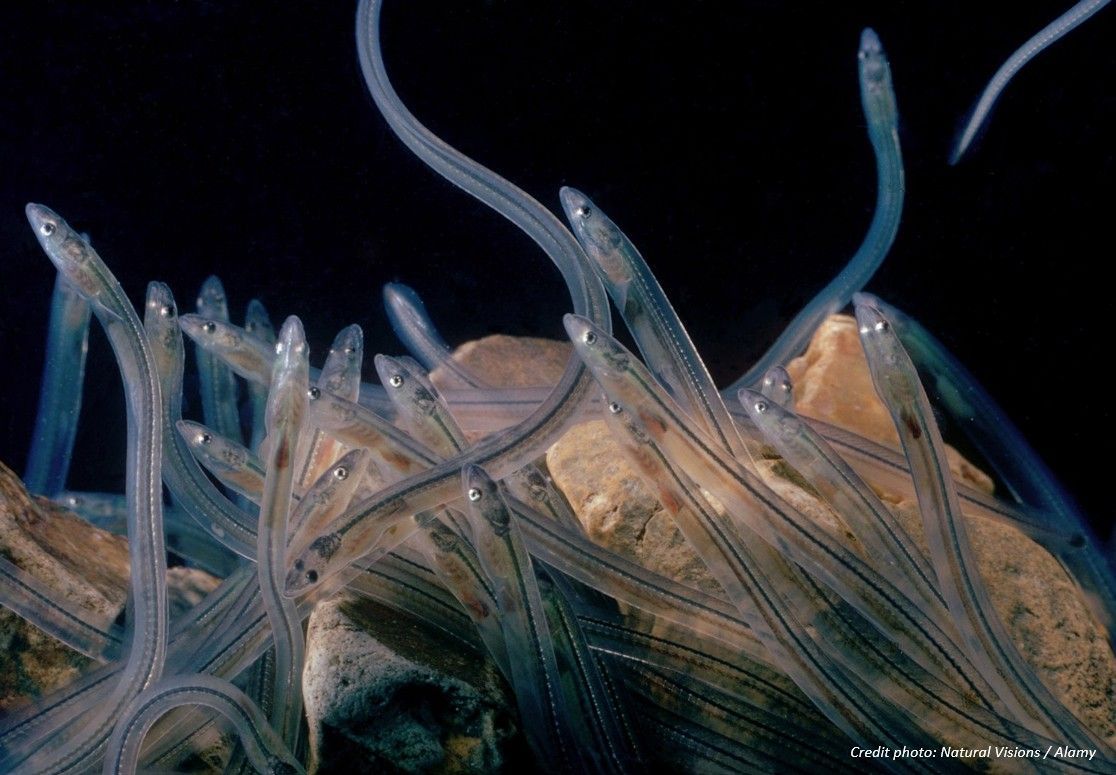
[11] Eels have a
complex life cycle, going through several different life stages and generally live for 10–20 years. The very small, translucent eels arriving at European coastlines every year are called
glass eels. When they reach brackish or fresh waters, they transform into less transparent
elvers, and then grow into
yellow eels, which live along our coasts, in rivers and lakes for up to 25 years. When mature, they transform again into
silver eels, which will undertake the long journey to the Sargasso Sea to spawn.