NGOs to EU decision makers: Commit to a Genuine Baltic Sea Recovery Plan
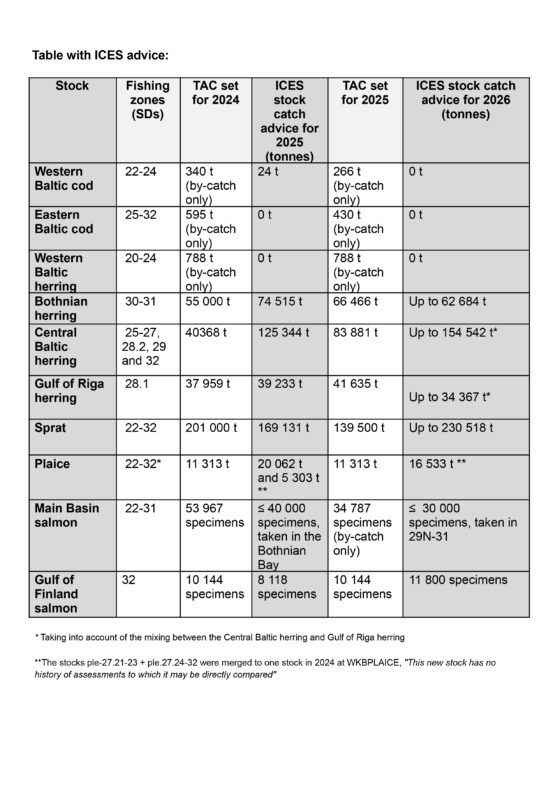
Key Baltic fish populations are in crisis, warn environmental NGOs. New scientific advice from the International Council for the Exploration of the Sea, ICES, confirms the poor condition of key Baltic fish populations, several of which remain collapsed (1). EU fisheries ministers must set 2026-catch limits well below ICES advice and prioritise long-term recovery over short-term economic gains.
Cod collapse requires continued zero catch
The alarming state of Baltic cod populations persists. ICES maintains its zero-catch advice for Eastern Baltic cod in 2026 and 2027. Despite closure of the direct fishery since 2020, the stock shows no signs of recovery.
For the first time, ICES also recommends zero catch for Western Baltic cod. The stock has suffered from weak recruitment since 2016. Despite the targeted direct fishery being closed since 2022, scientists now advise a full fishing halt for 2026 and 2027 (2).
ICES also recommends actions to restore degraded marine ecosystems affected by pollution and the climate crisis. These measures, if implemented, are expected to have both direct and indirect effects on reducing mortality and improving the poor condition of both cod populations.
Higher catch advice, despite low herring biomass and sprat data uncertainty
Compared to last year, the ICES advice for Central Baltic herring and sprat has increased, Central Baltic herring biomass is marginally above critical levels and risks genetic diversity loss, while the sprat advice increase relies on potentially unrepresentative recruitment data from a single Northeastern survey (3). NGOs warn that these apparent improvements mask significant concerns.
“On paper these catch limit increases look encouraging, but a closer reading of the ICES advice shows we’re still walking a tightrope,” said Cathrine Pedersen Schirmer, Senior Fisheries Policy Advisor at FishSec. “These fish populations remain fragile, and the uncertainties in the underlying data should make decision-makers proceed with caution.”
Uncertainty also clouds Gulf of Bothnia herring (4). Gulf of Riga herring, the only Baltic herring population consistently fished in line with the Baltic Sea Multiannual Plan, yet shows a declining spawning stock biomass (5). The advice for Western Baltic herring remains zero catch for 2026.
“Herring and sprat are vital to the Baltic Sea’s ecosystem and economy, serving as both valuable catches and essential prey for larger fish, marine mammals and birds” said Cathrine Pedersen Schirmer. “Overfishing, pollution, habitat loss, and a warming, oxygen-starved sea now threaten these species. Setting cautious catch limits—alongside habitat restoration—is crucial to protect the Baltic’s entire ecosystem.”
ICES headline advice does not consider legal safeguards for two herring stocks
In addition, ICES headline advice does not take into account legal safeguards under the EU Baltic Multiannual Management Plan designed to prevent the collapse of fish stocks (6) When it comes to Total Allowable Catches (TACs) for 2026 this important provision applies to Central Baltic and Gulf of Bothnia herring (7). Most concerningly warn NGOs, as the Fisheries Council has broken this legal rule twice already in relation to Baltic stocks.
“We cannot once again ignore the fact that the advised catches would push both these herring stocks beyond the determined biological and legal risk limit. These are not just numbers”, said Aimi Hamberg, Marine Policy Officer at Coalition Clean Baltic, “they reflect real threats to the reproductive capacity of the stocks. Ignoring the legal safeguards in the Baltic Sea Multi Annual Plan once again could lead to long-term stock collapse and socioeconomic fallout.”
“ICES advice on fishing opportunities should always be used in conjunction with the existing binding law. We understand and expect that ICES advice for the Baltic Sea fish stocks will be used by the decision makers respecting the provisions of the Baltic Sea Multiannual Plan and considering its important safeguards. In practice this would mean much lower catch levels for Central Baltic herring and Gulf of Bothnia herring, compared to the headline advice.” said Justyna Zajchowska, Fisheries Lead in WWF Baltic Sea Programme.
Scientists flag poor flatfish condition and call for habitat restoration
ICES flag the poor flatfish conditions and call for habitat restoration. Over the last five years, Baltic plaice — and other flatfish — have shown sharp declines in weight-at-age and overall condition, a clear sign of ecosystem stress (8).
“Fisheries management must account for the reality that our marine ecosystem has been damaged by human activities and climate change,” said Lioba Schwarzer, Lead of Marine Conservation at DUH. “ICES scientists are now recommending habitat restoration efforts, specifically improving oxygen levels on the seafloor, which will ultimately help improve the health of the plaice stock.“
Ecosystem failure and data gaps demand more precautionary limits
ICES’ latest advice exposes significant uncertainties and data gaps, such as misreported landings (especially for herring and sprat), missing Russian catch figures, and incomplete biological data, that undermine Baltic Sea stock assessments.
“In light of the current biodiversity and climate crises, it is imperative to rebuild all fish populations well above sustainable and productive levels in order to enable them to cope with and mitigate mounting pressures”, said Rémi Cossetti, Marine Policy Officer at Seas At Risk, “policymakers must invest in the resilience of fish populations and ecosystems by adopting fishing limits well below the maximum catch level advised by ICES to ensure the long term sustainability and resilience of the fisheries sector and the coastal communities that depend on them.”
NGOs therefore urge EU decision-makers to urgently agree on a Baltic Sea Recovery Plan, that includes adopting precautionary limits that restore and maintain resilient fish populations amid the ecosystem and climate crisis.
__END
CONTACTS:
- Aimi Hamberg, Marine Policy Officer, Coalition Clean Baltic, aimi.hamberg@ccb.se
- Cathrine Pedersen Schirmer, Senior Fisheries Policy Officer, FishSec, Cathrine@fishsec.org +45 21977905
- Lioba Schwarzer, Team Lead Marine Conservation, Deutsche Umwelthilfe, schwarzer@duh.de, +49 171 9851538
- Justyna Zajchowska, Fisheries Lead, WWF Baltic Sea Programme, jzajchowska@wwf.pl
- Rémi Cossetti, Marine Policy Officer, Seas At Risk, rcossett@seas-at-risk.org
- Magda Jentgena, Baltic Sea and Freshwater Programme Manager, Pasaules Dabas Fonds, mjentgena@pdf.lv, +371 28652770
- Joonas Plaan,Board member, Marine and Climate program, Estonian Fund for Nature (ELF), joonas.plaan@elfond.ee, +372 5665 2979
NOTES
- Linkto ICES advice.
- Western Baltic cod: Last year, ICES had advised no more than 24 tonnes catch for both recreational and commercial fishing. However, Ministers set a bycatch quota of 266 tonnes for 2025 to avoid limiting the flatfish fishery, which catches significant amounts of cod when using bottom trawls. As a result, commercial landings reached 155 tonnes in 2024, of which 123 tonnes are estimated to have been discarded—a practice that is illegal under the Common Fisheries Policy. ICES highlights that reducing cod bycatch in flatfish fisheries could enhance stock recovery.
- ICES advice for Central Baltic herring: a maximum of 154,542 tonnes for 2026 (taking account of the mixing between the Central Baltic herring and Gulf of Riga herring) vs 125,000 tonnes for 2025, sprat: a maximum of 230,518 tonnes vs 165,000 tonnes for 2025. Central Baltic herring biomass remains just above the critical conservation reference point, and with vulnerable sub-populations not being managed separately there is a risk that genetic diversity may be lost forever. ICES’s higher sprat advice is based on promising recruitment data from just one northeastern survey that may not reliably predict biomass increases across the entire Baltic stock area.
- Gulf of Bothnia herring: ICES advises a decrease to a maximum of 62,684 tonnes for 2026 (down from 74,515 tonnes), noting fluctuating weight-at-age linked to changing prey availability.
- Gulf of Riga herring: ICES limits 2026 catches to a maximum of 34,367 tonnes (down from 45,235 tonnes). Western Baltic spring-spawning herring (WBSS): ICES advises zero catch for 2026 and has done so since 2019. ICES highlights that without additional area and seasonal restrictions on the herring fishery in the North Sea in 2026, catches of WBSS herring in the North Sea will be unavoidable, delaying the recovery of the stock.
- Art. 4.6 of the Baltic Sea Multiannual Plan requires fishing opportunities to be set in such a way that there is less than a 5% probability of the stock’s spawning biomass (SSB) falling below critical biomass levels (Blim).
- ICES headline advice for Central Baltic herring and Gulf of Bothnia herring does not take into account the safeguard under Art. 4.6 of the Baltic Sea Multiannual Plan, which requires fishing opportunities to be set in such a way that there is less than a 5% probability of the spawning stock biomass (SSB) falling below critical levels (Blim) – “the 5% rule”. If fishing limits for Bothnian herring are set in line with the ICES headline advice of 55,869 to 62,684 tonnes, the probability of the spawning stock biomass falling below Blim in 2027 is 9-10%, well above the 5% legal limit. To comply with the law, the total catch in 2026 cannot exceed 25,560 tonnes. For Central Baltic herring, the probability of spawning biomass being below critical levels in 2027 after fishing the recommended 120,378 to 157,996 tonnes is 5.9-8.1%—also above the 5% rule. To comply, the total catch in 2026 must stay under 103,073 tonnes.
- ICES advises a maximum of 16,533 tonnes for the plaice quota in 2026. This is a decrease compared to the separate advice of 5,303 tonnes for subdivisions 24–32 and 20,062 tonnes for SD 21–23, given for 2025.